
But I’ll speak for the trees.
Those of you who know me know that trees have been near the forefront of my mind now for a number of years. More or less since I moved to Colonie a decade ago, I’ve been concerned about the continued destruction of trees throughout the Town, both by developers and by individual homeowners, and the relative lack of new trees being planted.
This will be the first of a number of posts on the topic. I’m not plotting out a whole series or arc. I just know that I have a lot to say on the subject, and that because our societal relationship with trees impacts our daily lives (far more than most people realize), it’s worthy of a good deal of attention.
My neighbors have been removing trees (and not planting new ones) more or less as long as I’ve lived here. The most egregious example was when the man two doors down had fourteen trees removed from his 1/6 acre property last fall, appreciably degrading the feeling of our back yards1. I’m not sure why, but a tree removal down the street yesterday morning finally pushed me into action.
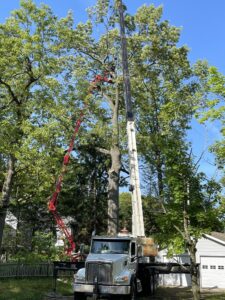
This majestic oak had likely been here as long as the neighborhood (roughly seventy-five years). Generations of people have enjoyed its shade and its beauty, not to mention the hundreds or thousands of birds, squirrels, and other wildlife that have benefitted from it. Its presence has anchored neighboring trees, reduced flooding (which does happen here, as it’s a local low-point), helped keep the nearby houses and streets cool, shaded numerous children (including my own) on their walks to and from school.
Another tree, even planted from a very mature sapling, will take twenty years or more to grow and longer to mature. That means this homeowner is making a generational choice for the whole neighborhood. If they sell the house in five or ten years, the next owners don’t have the option of retaining the tree (or planting new trees that can grow slowly, ready to take the place of the matriarchal tree when its time has come). Because trees are healthier in the presence of other trees (for a variety of reasons, only some of which are understood), a homeowner removing a tree on their own property also harms their neighbors trees. The choice is made in a moment and the deed is done in a day; the consequences are felt for decades.
Trees in a community do represent a challenge. Most of their benefits are experienced by the community: the beauty they provide (often flowering in the spring, glorious colors in the fall), the shade, reduced energy prices and a cooler environment for the surrounding area, reduced flooding, the ambience of calm and peace they can create for the neighborhood, etc. But the costs are largely borne by the individual homeowner: cleaning up and disposing of leaves, dealing with fallen branches after a storm, the risk of the tree falling on the house, even the costs of planting and tending new trees.
I mentioned at the outset that I intend this post to be the first of many on the topic of trees. Some of these posts (like this one) will be written more from a place of emotion, meant more to provoke thought and inspire action than to inform or guide that action with concrete specifics. I do hope that other posts will be able to cite supporting evidence and link to other resources, especially for those of us interested in the health of the tree populations in our communities. The challenge of community trees is very solvable. But we until we agree it needs to be solved and work on constructive solutions, it will only get worse.