
The Colonie PD recently published a post on Facebook with the same headline. I’ve captured a screenshot of the post, for anyone who doesn’t care to visit Facebook.
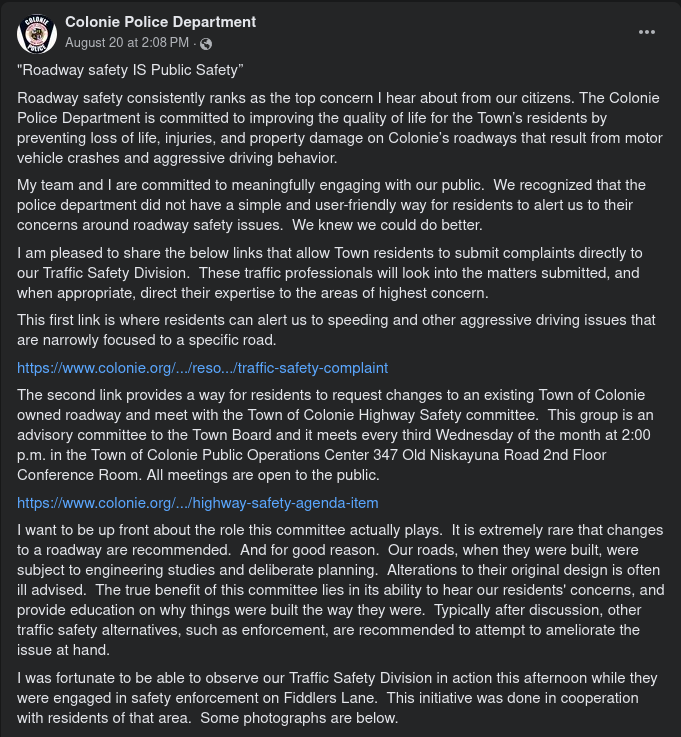
It started off strong (the headline is 100% accurate), but it ended up turning into an apology for not doing anything.
The problem is that traffic, and traffic safety, isn’t really a police/enforcement problem. It’s an infrastructure problem. The police aren’t really in a position to do very much (and they’re clearly not interested in doing even that, given how blase they are about enforcing even basic things like the requirement that every vehicle display a license plate).
The post’s penultimate paragraph sums up the police’s intent to do nothing:
I want to be up front about the role this committee actually plays. It is extremely rare that changes to a roadway are recommended. And for good reason. Our roads, when they were built, were subject to engineering studies and deliberate planning. Alterations to their original design is often ill advised. The true benefit of this committee lies in its ability to hear our residents’ concerns, and provide education on why things were built the way they were. Typically after discussion, other traffic safety alternatives, such as enforcement, are recommended to attempt to ameliorate the issue at hand.
Despite that, I still intend to fill out the form they’ve linked, highlighting a few of the problem spots in the Town. We have to start applying pressure using every means available, and it only takes a few minutes to submit a report.
I’ll create a follow-up post (and link to it here) with the reports I submit, in case anyone else wants to sign onto them by submitting their own similar reports for the same problems/locations.
It’s an infrastructure problem
Even if the Colonie PD had the best intent, the bottom line is that there are only 115 officers in a Town of 85,000 people (not including the tens of thousands more who pass through from outer suburbs). They simply aren’t in a position to enforce increasingly outdated traffic laws.
Speed can be controlled by narrowing lanes and roadways, adding speed humps, raising crosswalks, and creating curb bump-outs at pedestrian crossings. Additional 4-way stops throughout residential neighborhoods, and reducing the curb radius for turns will also help.
Protecting bus stops, pedestrian crossings, and other areas where people are likely to be (not to mention physical infrastructure like street lights, utility poles, and street signs) can be done by placing bollards and moving guardrails so they’re between traffic and people. Creating pinch-points, where drivers feel compelled to slow down to prevent damage to their (increasingly large) vehicles will reduce vehicle speed, and thereby traffic fatalities far more effectively than any amount of police presence or enforcement (and have the added bonus of not putting any officers’ lives at risk).
At the end of the day, it’s concrete and steel that will stop drivers from threatening public safety.